

Archive for 'Web 2.0'
Have you Obamafied your website today?
Nobody likes an antisocial site. Social sites are winning the traffic stakes, and even elections. A politician from Honolulu showed us how it’s done.
I never thought that one of the best examples of a social site would come from a politician, but it did. It’s a lesson for all websites, including media players, on how […]
Click on headline link to visit matthewbuckland.com for full article
How tagging enhances SEO: An example
Here is a perfect example of how a comprehensive semantic tagging strategy can add to a site’s SEO (Search Engine Optimisation). Just did a search on Wikipedia and Mail & Guardian — the site I used to run back in the 50s :-). The results were interesting.
Instead of the Wikipedia entry showing up as the […]
Click on headline link to visit matthewbuckland.com for full article
ANC turns to social media
It looks like a battle front for this year’s elections will also be fought online. South Africa’s biggest political party is attempting to raise the (rather low) bar by announcing a mobile site, enhanced presences on social media platforms, and an online initiative, myanc.org to invite debate, comment and networking around their election manifesto.
The ANC […]
Click on headline link to visit matthewbuckland.com for full article
Too Many Encounters & Stories to Come up for Air
The blog has been a bit quiet lately but not through lack of things to say or visual content to post. And, 90% of that content has little to do with PR, marketing or the world of Web 2.0 due to an extended trip to Africa, a place that touched my soul for the first time more than twenty five years ago. Okay, perhaps the place ran my soul over with a bulldozer.
In addition to capturing one incredible story after another from a wide range of South Africans, Zimbabweans, Kenyans, Brits, Belgium and Dutch folks and more, I am meeting with technology and sustainable energy companies and people, as well as designers, artists, technology and social media visionaries.
Additionally, a cast of journalists, bloggers, scientists, botanists, gardeners, photographers, architects, farmers, pilots, environmentalists, politicians, authors, sculptors, bankers, real estate agents, miners, chefs, musicians, dancers, faerie preservationists, dreamers, psychologists, vets, game hunters, jewelery designers, psychics, solar experts, hot air balloon racers, sailors, wood carvers, captains and builders have all landed in our path between the Zimbabwe border and the most southern point in Africa Cape Argulas.
Connectivity has been slow and limited and given that a lot of the content we've captured has included video, stories will come when they come, no doubt slowly until there's decent broadband or until the encounters stop coming. Look for images in the next few days as placeholders until the stories can be unveiled. And as for images, this has been by far, my favorite place to shoot on the planet. Costa Rica and Paris are close seconds. Morocco is probably third.
Web predictions for the new year
We may be in the throes of a global financial crisis, but that doesn’t mean we won’t see innovation on the web. In fact, leading trend analysis blog Read Write Web reminds us of the old cliché that “tech innovation thrives in times of recession”. Tight economic conditions incubate intense creative and lateral thought, because […]
Click on headline link to visit matthewbuckland.com for full article
Zoopy: YouTube meets Flickr meets Blogging, South African Style
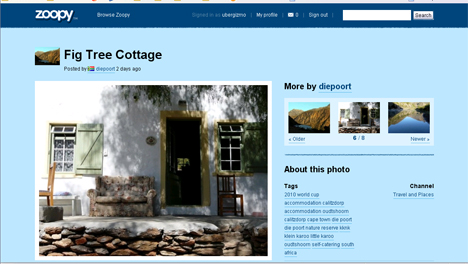
[South Africa Blogging Tour 08] Nic Haralambous is part of the Blogging Tour and the General Manager of Zoopy. Founded in 2006 by Pat Elk, Jason Elk and Gerry da Silva, Zoopy is the South African Youtube and a new version was just launched on Monday. I took the opportunity to talk with Nic about the new website during the bus trip to !Kwa ttu, the cultural center of the San people.
In South Africa, the bandwidth is expensive and Yoututbe does not have a server there, so it takes forever to upload movies. There was a real need for a local video sharing site and Vodacom, one of the three mobile carriers in South Africa, is an investor in the company since early 2008. The new features include the launch of Zoopy TV, 3 channels where journalists with “extreme blogging training” (Nic), post breakings news nation wide, the multiple uploads capability (up to 20 files simultaneously), and the mobile version, available at m.zoopy.com.
Read more after the jump
Key blogs about innovation, media & biz online
When it comes to news about internet startups, web trends and innovations, blogs are a way better source than traditional media. If you want to know what’s happening on the web, there are some key blogs that should form part of your daily reading. Most serious online fundis use at least 2 or 3 […]
Click on headline link to visit matthewbuckland.com for full article
eBay South Africa “launches” damp squib
Worldwide dot.com stalwart eBay has stealthily launched a watered-down web presence in South Africa, “Ebay South Africa” on ebay.co.za. Was in a meeting with internet guru Ronnie Apteker (sorry Ronnie!) and he pointed me to it. It apparently launched in the last few days, although they have owned the co.za for years.
Will be interesting […]
Click on headline link to visit matthewbuckland.com for full article
Valley-Ho!
If there’s one theme that I’ve thought about, talked about and written about the most over my career covering tech and finance it’s the debate of whether you need to relocate to Silicon Valley to be successful. In my case, there’s no doubt I’ve had a better career just by covering business in the Valley, so it’s hard for me to believe anyone who wants to profit from the startup ecosystem wouldn’t be more successful here. Over the years, I’ve read a lot of weak treatises that say Valley isn’t all that great, ultimately coming off either bitter or just naive, but here is a pretty nice piece arguing against Valley relocation. Although, I’m still not convinced.
The strongest point the writer makes is about the damaging affects of the temptation to bulk up on venture capital and not figure out a real business. There is a certain “Valley game” you can get sucked into that can cloud good judgment. Although, I think tying that to Web 2.0 is a bit misleading since the hottest Web 2.0 companies all bootstrapped themselves or lived on angel funding for most of their early days. And besides, really, isn’t knowing when to take money just a test of a good entrepreneur? Hell, I’ve been offered money to start a company before. It’s not access to cash that defines your worth, it’s the discipline to know if that’s the right thing for you and your business.
Per the point about it being harder to retain great people in the Valley, that argument can go both ways. Pro argument for the Valley: the Valley has more talent than anywhere else and they all know the costs and risks of being at a startup. Con: the best people always want to flock to the next hot startup. Personally, I think the latter is overstated. There are certain momentum seekers who will flock to the next pre-IPO name, but those are the people most entrepreneurs don’t want working for them, so actually that phenomenon can be a nice filter. After all smart people work at Mozilla, a company that has said it will never go public. Also, if startups are worried a hotter name will steal their coders, doesn’t that put a healthy pressure on startups to be the best they can. I just generally think competition is good for business. I guess it comes down to what you want: a nice business that might get acquired or to really build something big and lasting. If it’s the latter and you can’t make it in the Valley, are you really good enough to be a billion dollar company?
For good measure, here is a nice piece Evan Williams wrote about it earlier this year. As you’ll see he’s mixed too, but I think his story underscores the more practical point: There’s an undeniable correlation with being in the Valley and success, so if it’s easier why wouldn’t you just move? Evan also points out the social advantages of living in a place where there’s so much creativity and entrepreneurial spirit in the air. Indeed, that seems to be the part people outside the Valley miss. Because it’s one of those things you need to be around to understand. It is the norm to want to build something here– that’s incredibly powerful to entrepreneurs in other parts of the world who are used to feeling like outcasts or silly dreamers.
I’m thinking about this a lot today (while everyone else still seems to be obsessing about Micro-hoo!), as I finish up a column on Isreali entrepreneurs for BusinessWeek. I talked about this a lot over there: Whether all Israeli startups have to move their HQ to the Valley or not, so check out my column this week for more. Israel has benefitted greatly from this symbiotic relationship, but the question is whether it holds them back from being a true technology hub. One interesting note: the people who tend to argue you don’t have to move usually aren’t in the process of building a company. They have either already made their money (frequently, by relocating to the Valley) or are investors, attorneys or other members of the startup ecosystem in markets outside the Valley. In other words, there’s a logical argument that boosters of Atlanta, Austin, London or Tel Aviv can make, but when it’s actually your business and you’re the one trying to mitigate risk of failure, it’s another matter.
There’s something about it that’s like looking at a baseball team’s lineup in April. It could look like a killer team on paper, but somehow on the field they just don’t gel. A city could have every natural resource a startup needs, and somehow lack that cultural glue, support system or whatever you want to call it that is really the intangible reason people don’t leave the Valley once they are here. A lot about this in my book, and I’d love to hear thoughts from any readers once it’s out and I (hopefully!) have readers.
And with that hackneyed analogy, I am off to a Sunday baseball game! Any Israelis: send me some final thoughts before I file!
Cisco Israel Uses Tech to Build Tolerance
Can geographically dispersed teens in Israel and the Mediterranean countries create a web based community to increase their own improvement in school, their self-image (believing in themselves and wanting to change), English proficiency, and more their openness to others? Cisco Israel (a branch of the Global Internet company based in the SF Bay Area) is piloting a program that could be scaled to thousands to find out.
Zika Abzuk-Darnell is Cisco Israel Manager of Public Benefit Investment Europe and Emerging Markets.
She manages the social responsibility team. These are large projects that use technology for economic opportunity. Cisco is investing in youth. Web 2.0 technology is a mirror of Western society: the individual is the one who ventures and connects. In the Middle Eastern and African cultures it is difficult to do a program strictly for individuals. They view themselves as part of family and community.
Zika talked about an intriguing pilot program MYTEC ( Mediterranean Youth Technology club).
MYTEC shows how technology can be used for positive social change?web 2.0 with guidance. This enables students to learn about each other and participate. The teens (14-15 year olds) are recruited from Morocco, Egypt, Yemen, Israel, Palestine, Turkey, Greek Cyprus and Portugal. Religion and ethnic identity play an important role in each country. The challenge is: How to foster the interpersonal skills to create business leaders in a global economy that transcends religion and ethnicity.
Cisco selected young leaders (20-30 year olds) in each country to be the instructors for the teen participants. The company brought 20 of these leaders to Marrakesh to teach them English over a two week intensive training program. They also taught them team building and tolerance of others skills. Together they created and built an Internet platform to relate to the kids. One of the instructors was an Israeli Arab. The Arabs who live outside Israel did not know there were Israeli Arabs. They became a team; the social curriculum they developed for kids they experienced themselves. For example, each instructor brought a game from his country and taught it to the group to play together.
Instructors created a virtual development team. The knowledge of the platform is now In seven out of eight countries. Students are in classrooms twice a week in a community knowledge center equipped with computers to learn English, technology skills, and guided activities to learn about each others? culture. The Moroccan kids created a video of how to cook a Tagine. The Turkish kids tried to cook the dish together. They teach each other songs from their home countries. Using video conference software, they have guided conversations and they can post photos.
However, as with any community site trying to bridge differences during national conflict, there can be problems. For example, one of the Moroccan kids posted a message after 140 people were killed in Gaza that Israelis are slayers. Here is when Instructors showed ownership of the program. They took this example and turned it into a lesson on ethics of how to communicate on the Web. First, the instructors enabled a student debate on rules for posting opinions. Eventually, the students agreed on a protocol for confrontational messages in their web community. They discussed the caricature of Mohammed, what is allowed and freedom of speech; Israeli kids spoke of what they thought should be allowed. The kids in each country had their own debate; they developed ground rules of how to communicate. The kids have become ambassadors of change within communities. They learn technology and volunteer what they learn and open the community center and invite parents.
MYTEC is a good example of how Web 2.0 interactivity can be used for positive social change.